How Many Sheets of Plywood Do I Need?
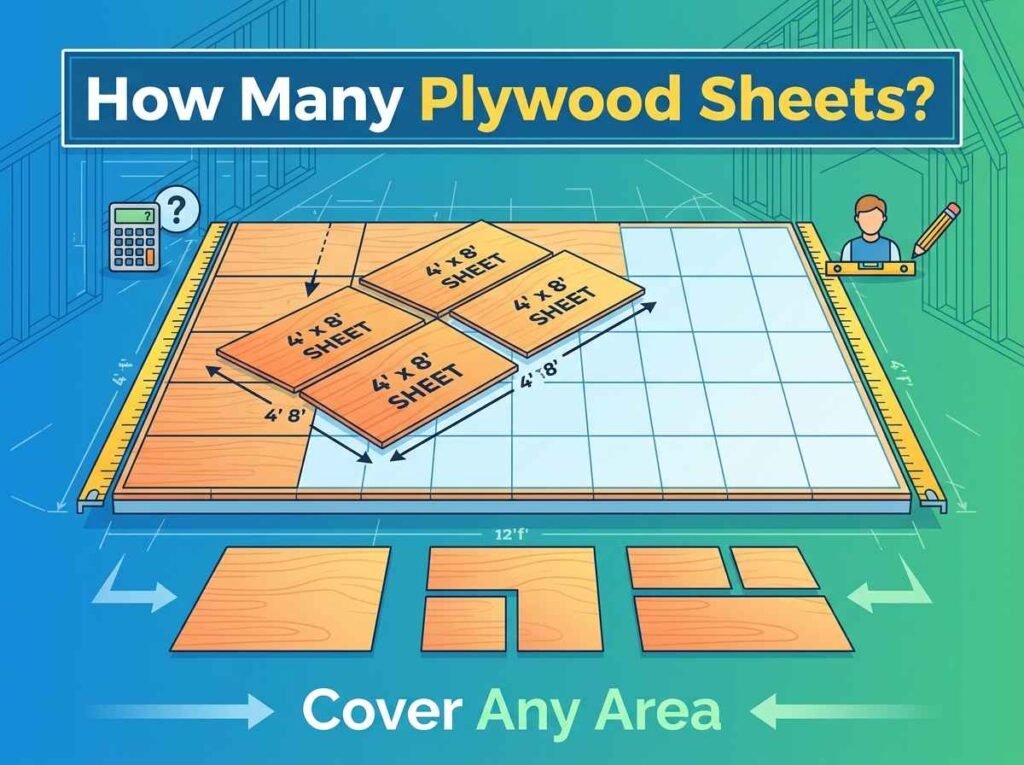
Whether you are laying a subfloor, sheathing a wall, or building a deck, plywood is sold in sheets, so the real question is always how many sheets you need. Buy too few and the job stalls; buy too many and you waste money. Working out how many sheets of plywood you need is simple once you know your area and sheet size, and a small waste allowance keeps you covered.
This guide walks through the method, a worked example, and the fastest way to get an exact count.
Start With the Area to Cover
Plywood covers a flat surface, so the first step is to find the total area you need to cover in square feet. Measure the length and width of the surface in feet and multiply them together.
For example, a floor that is 12 feet long and 10 feet wide has an area of 12 × 10 = 120 square feet. That total area is the foundation of the whole calculation.
Know Your Sheet Size
The next piece is how much area one sheet of plywood covers. The most common plywood sheet is 4 feet by 8 feet, which covers 32 square feet. Smaller sheets are also sold:
- 4 × 8 ft sheet: 32 square feet
- 4 × 4 ft sheet: 16 square feet
- 2 × 4 ft sheet: 8 square feet
Most building projects use the standard 4 by 8 sheet, so unless you are buying pre-cut smaller panels, 32 square feet per sheet is your figure.
The Formula: Divide and Round Up
Once you know your total area and your sheet coverage, the calculation is simple: divide the area by the coverage of one sheet, then round up to the next whole sheet.
Continuing the example: 120 square feet ÷ 32 square feet per sheet = 3.75 sheets. Since you cannot buy three-quarters of a sheet, you round up to 4 sheets. Always round up, because a partial sheet still means buying a full one.
Add a Waste Allowance
Rounding up covers the fractional sheet, but you should still add a waste allowance on top. Cutting sheets to fit around corners, openings, and edges creates offcuts you often cannot reuse, and mistakes happen. A waste allowance of 10 percent is a sensible cushion for most jobs.
On a larger project, that 10 percent can mean an extra sheet or two, which is far better than stopping work to make another supply run. A plywood calculator adds this allowance automatically so your count is realistic, not just theoretical.
Don’t Forget Waste From Cuts
Beyond the percentage allowance, think about how your sheets will actually be cut. If your surface has an awkward shape or many small sections, you will waste more material than a simple rectangle, because each cut leaves an offcut. For those jobs, lean toward the higher end of the waste range so you are not caught short.
A Note on Plywood Thickness
While thickness does not change how many sheets cover an area, it does matter for your project and your budget. Subfloors and structural sheathing use thicker plywood, while cabinet backs and light panels use thinner sheets. Thicker plywood costs more per sheet and weighs more, so once you know your sheet count, factor thickness into your budget and check that the grade suits the job. The number of sheets stays the same, but choosing the right thickness makes sure the material performs as it should.
The Fast Way
The math is straightforward, but rounding and waste are easy to get wrong under pressure. The reliable method is a plywood calculator: enter the length and width of your area, pick your sheet size, and it returns the number of sheets you need, rounded up with a waste allowance already included.
Frequently Asked Questions
How many sheets of plywood do I need?
Divide the total area you are covering by the area of one sheet, then round up. A standard 4×8 sheet covers 32 square feet, so a 120-square-foot floor needs four sheets.
What is the area of a standard plywood sheet?
A standard 4-foot by 8-foot sheet covers 32 square feet. Smaller 4×4 and 2×4 sheets cover 16 and 8 square feet respectively.
Why do I need to add waste for plywood?
Cutting sheets to fit around corners and edges leaves offcuts you cannot always reuse. A 10 percent allowance makes sure you have enough to finish the job.
Should I always round up plywood sheets?
Yes. You cannot buy a partial sheet, so any fraction means purchasing another full sheet. Always round up to the next whole number.
Calculate Your Plywood Now
Once you know your area and sheet size, the count is quick, and a tool removes any rounding errors. Open the plywood calculator to get your sheet count in seconds. Working on a bigger build? The concrete calculator and brick calculator handle those materials just as easily.