What Size Generator Do I Need for My House?
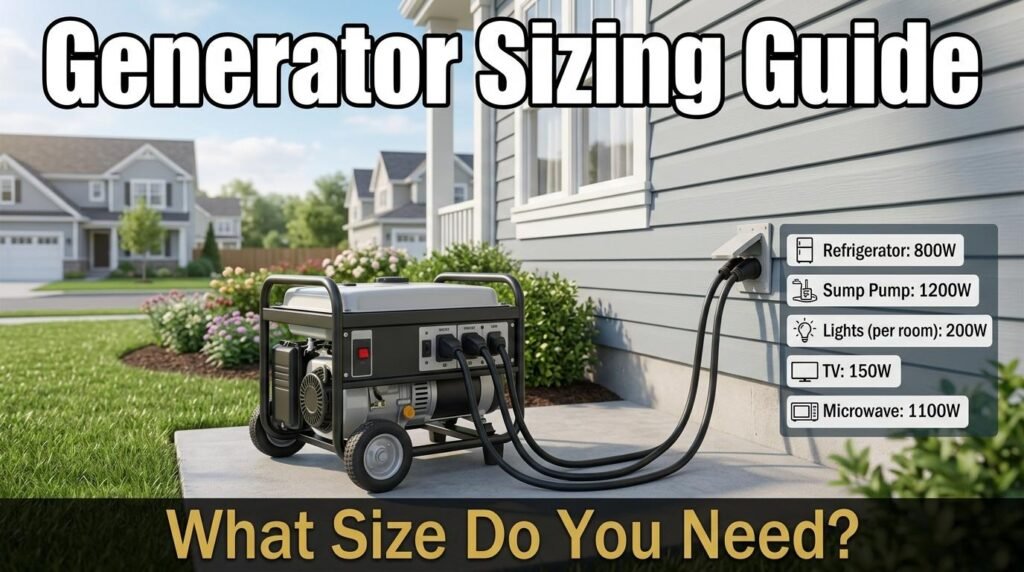
Buying a generator without knowing your electrical load is like buying shoes without knowing your size — you will either get something too small to be useful or something too large that wastes money. The right approach is to add up the wattage of everything you want to power, apply a safety margin, and match the total to a generator rating. The whole process takes five minutes and saves you from discovering your generator is too small in the middle of a blackout.
Step 1: List What You Want to Power
Not everything in your house needs to run during an outage. Most people prioritize the essentials: the refrigerator to keep food safe, a few lights, the internet router, phone chargers, and depending on the season, heating or air conditioning.
Start by writing down every appliance and device you want to keep running, along with its wattage. You can find the wattage on the label, in the manual, or by searching the model number online. Here are typical wattages for the most common household items:
A refrigerator runs at about 150 watts continuously. A chest freezer uses around 100 watts. A window air conditioner draws 1,200 watts, while a central AC system can pull 3,500 watts or more. A space heater uses about 1,500 watts. A sump pump draws 800 watts. LED light bulbs use about 10 watts each, so 10 bulbs add 100 watts. A Wi-Fi router uses 12 watts. A laptop uses 65 watts, and phone chargers about 5 watts each. A microwave draws about 1,000 watts but only when in use. A TV uses roughly 80 watts.
Step 2: Add Up the Running Watts
Add the wattage of every appliance you listed. This gives you your running load — the total power draw when everything is operating at steady state.
For a typical essential-power setup, the math might look like this: refrigerator (150) plus freezer (100) plus 10 LED bulbs (100) plus router (12) plus two phone chargers (10) plus a laptop (65) plus a window AC (1,200) equals 1,637 watts, or about 1.6 kilowatts.
For a more comprehensive setup that includes a sump pump, microwave, TV, and space heater, the total can reach 4,000 to 6,000 watts depending on the combination.
An electrical load calculator does this math for you — add your appliances from a preset list, set the quantities, and it totals everything automatically with the generator size included.
Step 3: Account for Starting Watts
Many appliances draw a surge of extra power when they first turn on. Motors, compressors, and pumps are the biggest offenders. A refrigerator that runs at 150 watts might draw 600 watts for the first few seconds. A sump pump rated at 800 watts might spike to 1,200 or more on startup.
The general rule is to add 25 percent to your total running watts to cover these surges. If your running total is 4,000 watts, you need at least 5,000 watts of generator capacity. Some guides suggest identifying the single largest starting-watt appliance and adding its surge on top of the running total, which gives a more precise number.
Step 4: Match to a Generator Size
Generators are rated in watts or kilowatts, and sometimes in kVA. For home use in the US, watts and kilowatts are the most common ratings. Here is a general guide to common generator sizes and what they can handle:
A 3,000 to 4,000 watt portable generator handles the basics: a refrigerator, lights, router, chargers, and a fan. This is the minimum for a short outage.
A 5,000 to 7,500 watt generator covers the basics plus a window AC or a sump pump and a microwave. This is the most popular home backup size.
A 10,000 to 12,000 watt generator can run a small central AC, multiple large appliances, and a few convenience items at the same time. Good for longer outages or larger homes.
A 20,000+ watt whole-house standby generator (typically propane or natural gas) can power nearly everything in a standard home including central HVAC, the water heater, and the electric range.
Common Mistakes to Avoid
The most common mistake is adding up only running watts and forgetting starting surges. This leads to buying a generator that trips its overload protection the moment the refrigerator compressor kicks in.
The second mistake is assuming you need to power everything. Running the central AC, the electric oven, and the clothes dryer simultaneously requires a massive generator. Prioritize what you actually need during an outage and skip the high-draw luxuries.
The third mistake is ignoring altitude. Generators lose about 3 to 4 percent of their rated power for every 1,000 feet above sea level. If you live at high elevation, size up accordingly.
Generator Types Compared
Portable generators (gasoline) are the most affordable option at $300 to $1,500 for 3,000 to 7,500 watts. They are loud and need manual setup but work well for occasional outages.
Inverter generators are quieter and produce cleaner power (safe for electronics) but cost more — $500 to $3,000 for similar wattage. Best for sensitive electronics and frequent use.
Standby generators (natural gas or propane) are permanently installed and turn on automatically during an outage. They cost $3,000 to $15,000 plus installation but provide seamless whole-house backup with no manual effort.
Frequently Asked Questions
How do I calculate the right generator size?
Add the wattage of every appliance you want to run at the same time, then add 25 percent for startup surges. The result in watts is the minimum generator capacity you need. An electrical load calculator does this automatically.
Can a 5,000 watt generator run a house?
It can run the essentials — a refrigerator, freezer, lights, router, and a window AC or sump pump. It cannot run a central AC system, electric water heater, or multiple high-draw appliances at the same time.
What is the difference between running watts and starting watts?
Running watts is the continuous power draw during normal operation. Starting watts is the temporary surge when an appliance first turns on, which can be two to three times higher for motors and compressors.
Should I get a portable or standby generator?
Portable generators are affordable and work for occasional short outages. Standby generators cost more but turn on automatically, run on natural gas or propane (no refueling), and can power the whole house. Choose based on your budget and how often you lose power.
Calculate Your Generator Size Now
Skip the guesswork and get the exact number. Open the electrical load calculator, add your appliances, and see the total watts, monthly cost, and recommended generator size in seconds. For more construction and home tools, see the concrete calculator and brick calculator.