How to Calculate Electrical Load for Your Home
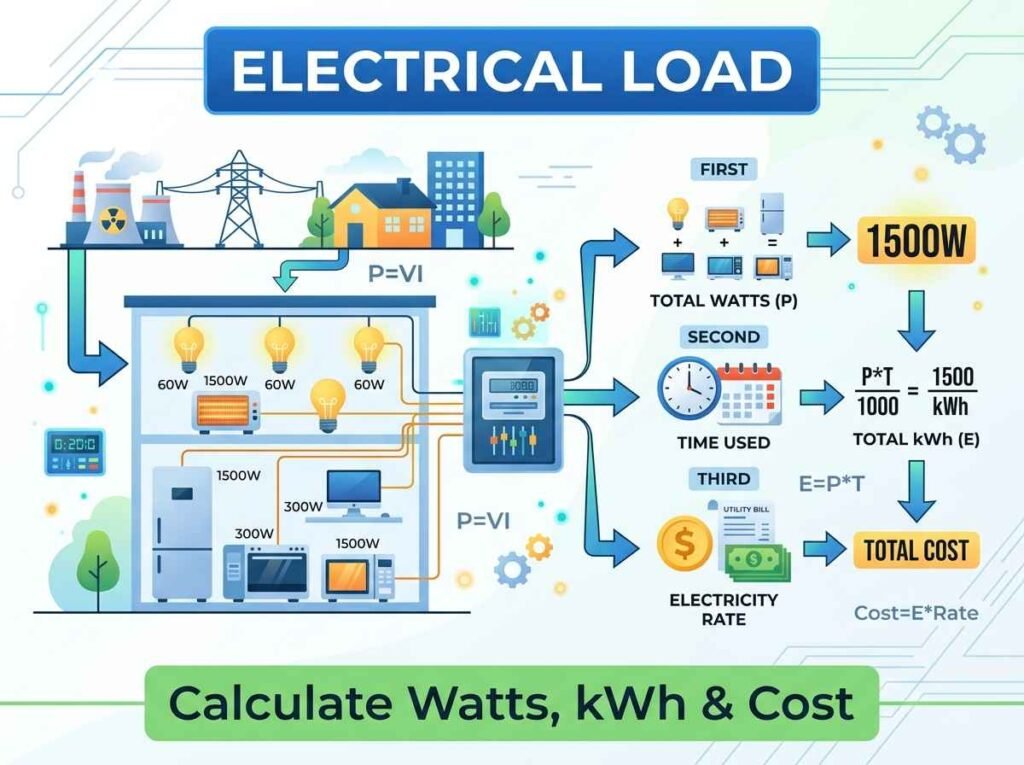
Knowing your total electrical load is one of the most useful things a homeowner can figure out, and you do not need to be an electrician to do it. Whether you are sizing a generator for backup power, trying to reduce your electricity bill, planning a panel upgrade, or exploring solar, the starting point is the same: add up what your home actually draws. This guide walks through the process step by step, explains the key units, and shows you the fastest way to get the numbers.
What Electrical Load Means
Your electrical load is the total amount of power your home draws at any given time, measured in watts. Each appliance, light, and device uses a certain number of watts while it is running, and your total load is the sum of all of them running together.
This number matters because your electrical panel, your wiring, and any generator or solar system you install all have a maximum capacity. Going over that capacity trips breakers, overloads equipment, or leaves you without enough power. Calculating your load tells you exactly where you stand.
The Units You Need to Know
Two units come up constantly in electrical calculations, and confusing them is the most common mistake:
Watts measure the power a device draws right now. A 1,200-watt air conditioner pulls 1,200 watts while it is running. One thousand watts equals one kilowatt.
Kilowatt-hours measure the total energy used over time. If that 1,200-watt air conditioner runs for 5 hours, it uses 1,200 × 5 = 6,000 watt-hours, or 6 kilowatt-hours. Your electricity bill is based on kilowatt-hours, which is why converting watts into kWh is the key to estimating your costs. A power consumption calculator does this conversion for you, turning a list of appliances into daily and monthly kWh totals so you can see the cost impact directly.
Step One: List Your Appliances and Their Wattage
The first step is to write down every appliance and device you want to include, along with its wattage. You can usually find the wattage on the label, in the manual, or by searching the model number online. Here are some common appliances and their typical wattages to give you a starting point:
A refrigerator uses roughly 150 watts, a window air conditioner around 1,200, a central air conditioning system around 3,500, a clothes dryer about 3,000, and a microwave about 1,000. Smaller devices add up too: a laptop is typically 65 watts, an LED bulb around 10, and a phone charger about 5.
If you are sizing a generator, include only the appliances you want to power during an outage. If you are estimating your electricity bill, include everything that runs regularly.
Step Two: Estimate Hours of Daily Use
Next to each appliance, estimate how many hours per day it runs. Some are straightforward: a refrigerator runs roughly 24 hours because its compressor cycles on and off all day. Others are intermittent: you might run a washing machine for one hour, a microwave for half an hour, and lights for eight hours.
Be realistic rather than generous. Overestimating hours inflates your numbers and makes the result less useful. If an appliance only runs a few times a week, average it out to a daily figure.
Step Three: Multiply Watts by Hours
For each appliance, multiply its wattage by the hours it runs per day. This gives you watt-hours per day. Divide by 1,000 to convert to kilowatt-hours. Add up all the appliances and you have your total daily energy consumption in kWh.
To get the monthly figure, multiply your daily total by 30. To estimate cost, multiply the monthly kWh by your electricity rate, which you can find on your utility bill. In the United States, the average rate is roughly 16 cents per kWh, though it varies widely by state and provider.
An energy consumption calculator handles all of this math automatically. You enter each appliance, its wattage, and hours of use, and it returns your total watts, daily and monthly kWh, and estimated cost at your rate. The electrical load calculator does exactly this, with common appliances preloaded so you can build your list in seconds.
Step Four: Find Your Total Load in Watts
While the kWh figure tells you about energy and cost over time, the total wattage tells you about capacity right now. Add up the wattage of every appliance you expect to run simultaneously, and that is your peak electrical load.
This number is what matters for sizing a generator, checking whether your panel can handle a new appliance, or planning a circuit. For a generator, you would add a safety margin of 20 to 25 percent on top of the total, because many appliances draw extra power when they first start up, especially motors and compressors. A 25 percent margin is the standard recommendation.
Using the Results
Once you have your total load and energy consumption, you can make informed decisions instead of guessing. If your electricity bill seems high, the breakdown shows which appliances use the most energy, so you know where to cut. If you are buying a generator, the total wattage plus the safety margin tells you the minimum capacity in kilowatts or kVA. And if you are exploring solar panels, your daily kWh consumption is the target your system needs to match.
Common Appliance Wattages Worth Knowing
A few appliances are worth highlighting because they dominate most homes. Central air conditioning is typically the single biggest load at 3,000 to 5,000 watts. An electric water heater draws around 4,000 watts. A clothes dryer pulls about 3,000. An electric oven uses roughly 2,500. An electric vehicle charger on a Level 2 circuit can draw 7,200 watts or more. These are the items that move the needle on your total load and your bill, so getting their wattages and usage hours right matters most.
Frequently Asked Questions
How do I calculate my home’s electrical load?
List every appliance with its wattage and hours of daily use, then multiply watts by hours for each one to get watt-hours. Divide by 1,000 to get kilowatt-hours, and multiply by your rate to estimate cost. A power consumption calculator does all of this in one step.
What is the difference between watts and kilowatt-hours?
Watts measure how much power a device draws right now. Kilowatt-hours measure the total energy used over time. Your electricity bill is based on kilowatt-hours.
How do I size a generator for my home?
Add up the wattage of everything you want to run at the same time, then add 25 percent for startup surges. The result in kilowatts or kVA is the minimum generator capacity you need.
What uses the most electricity in a typical home?
Central air conditioning, electric water heaters, clothes dryers, and electric ovens are usually the biggest draws. An EV charger is also significant if you have one.
Is an energy consumption calculator accurate?
It gives a reliable estimate based on the wattages and hours you enter. Your actual bill may vary slightly due to standby power, rate tiers, and seasonal changes, but the estimate is close enough for planning and budgeting.
Calculate Your Electrical Load Now
Knowing your load puts you in control of your energy costs and equipment decisions. Open the electrical load calculator, add your appliances, and see your total watts, daily and monthly kWh, estimated cost, and generator size in seconds. For more practical calculators, see the concrete calculator and percentage calculator.