How Big Is a KB? Bytes, KB & MB Explained
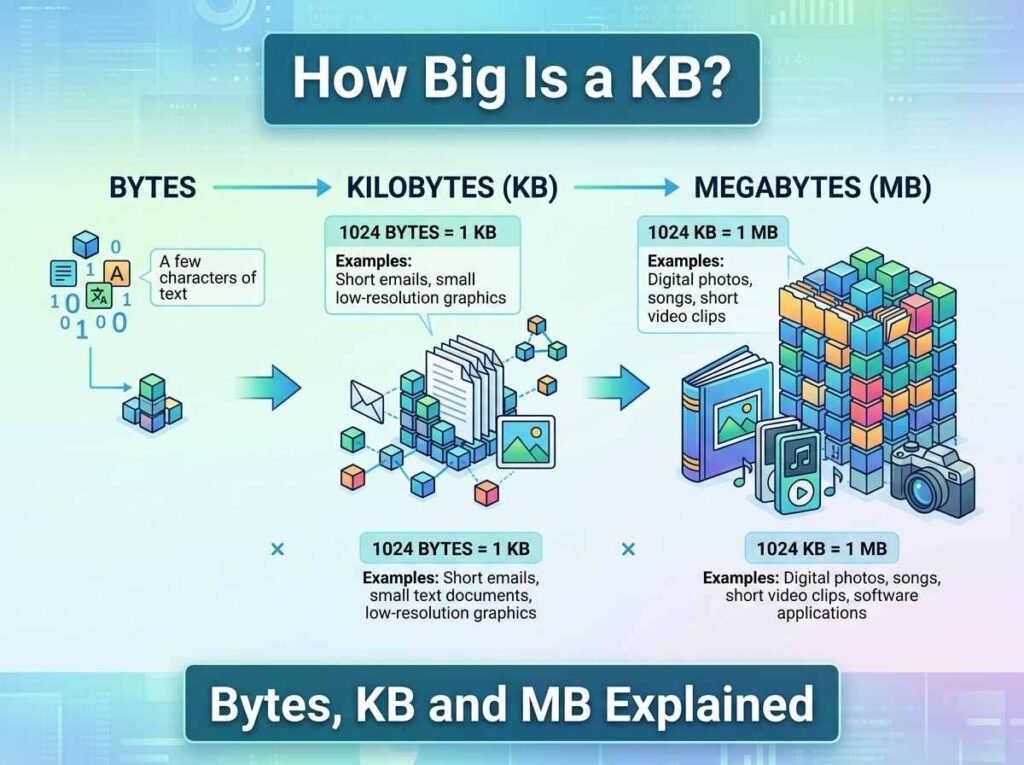
If you have ever wondered how big a KB actually is, you are not alone. Kilobytes, megabytes, and gigabytes describe the size of files and text, but the relationship between them confuses almost everyone at first. This guide explains exactly how big a KB is, how it relates to bytes and megabytes, and why a single character is not always one byte.
By the end you will be able to read any file size with confidence.
Start With the Byte
Everything digital is measured in bytes. A byte is a small unit of data, originally enough to store a single character of text like the letter A. Bytes themselves are made of even smaller units called bits — there are eight bits in one byte.
So the ladder starts here: 8 bits make 1 byte, and a byte is roughly one character of plain text. Once you have the byte, every larger unit is just a multiple of it.
How Big Is a KB?
A kilobyte (KB) is 1,024 bytes. You might expect it to be 1,000, since “kilo” usually means a thousand, but computers count in powers of two, and 1,024 is the nearest power of two. Some contexts round it to 1,000, but the traditional and most common answer is 1,024 bytes.
To put that in perspective, a kilobyte holds about 1,024 characters of plain text — roughly a short paragraph. A simple plain-text email is often just a few kilobytes in size.
How KB, MB, and GB Compare
The same pattern repeats as you go up the scale. Each unit is 1,024 of the one below it:
- 1 KB = 1,024 bytes
- 1 MB (megabyte) = 1,024 KB, or about a million bytes
- 1 GB (gigabyte) = 1,024 MB, or about a billion bytes
- 1 TB (terabyte) = 1,024 GB
So a megabyte is roughly a thousand kilobytes, and a gigabyte is roughly a thousand megabytes. This is why a 6 MB file is about 6,144 KB — you multiply by 1,024 each time you move down a level.
Why a Character Is Not Always One Byte
Here is where many people get caught out. The old rule that one character equals one byte is only true for basic English text. Modern text uses an encoding called UTF-8, where:
- Standard English letters and digits take 1 byte each.
- Accented letters and many symbols take 2 bytes.
- Most other scripts take 3 bytes.
- Emojis usually take 4 bytes, even though they look like one character.
This is why a short message full of emojis can be larger in bytes than a longer message of plain text. If you want the true size of a piece of text, you have to count its actual bytes, not just its characters. A text size and byte counter does exactly that, showing characters and real UTF-8 bytes side by side.
Why File and Text Size Matters
Understanding these units is not just trivia. Size affects real things you deal with every day:
- Message limits. An SMS, for example, is limited by bytes, so emojis use up the allowance faster.
- Page speed. Smaller files load faster, which improves your website and search ranking.
- Storage and uploads. Knowing how big something is helps you stay under upload caps and storage limits.
Being able to measure the exact size of text or estimate a file size puts you in control of all of these.
A Quick Way to Picture the Sizes
Real-world examples make the scale easier to remember. A short text message is usually under a kilobyte. A typical web page’s HTML might be 50 to 100 KB. A high-quality photo from a phone is often 3 to 6 MB, and a few minutes of music is around 5 MB. A full-length movie can run into several gigabytes. Once you connect the units to things you use every day, reading a file size becomes second nature, and you can quickly judge whether something will fit within an email attachment limit or an upload cap.
Frequently Asked Questions
How many bytes are in a KB?
A kilobyte is 1,024 bytes in the traditional computing sense. Some contexts round this to 1,000 bytes, but 1,024 is the standard answer.
How many bytes are in a character?
In UTF-8, a plain English character is one byte, but accented characters take two, many scripts take three, and emojis usually take four.
How big is 6 MB in KB?
Six megabytes is about 6,144 KB, since one megabyte equals 1,024 kilobytes.
Why does my text take more bytes than it has characters?
Because special characters and emojis use multiple bytes each in UTF-8, the byte total can be larger than the visible character count.
Measure Your Text’s Real Size
Now that you know how big a KB is, you can check the exact size of any text yourself. Open the text size and byte counter to see characters, bytes, and kilobytes instantly. For more handy utilities, see our guide to the best free online tools for developers.