How Much Does Amazon Take Per Sale? (2026 Fees)
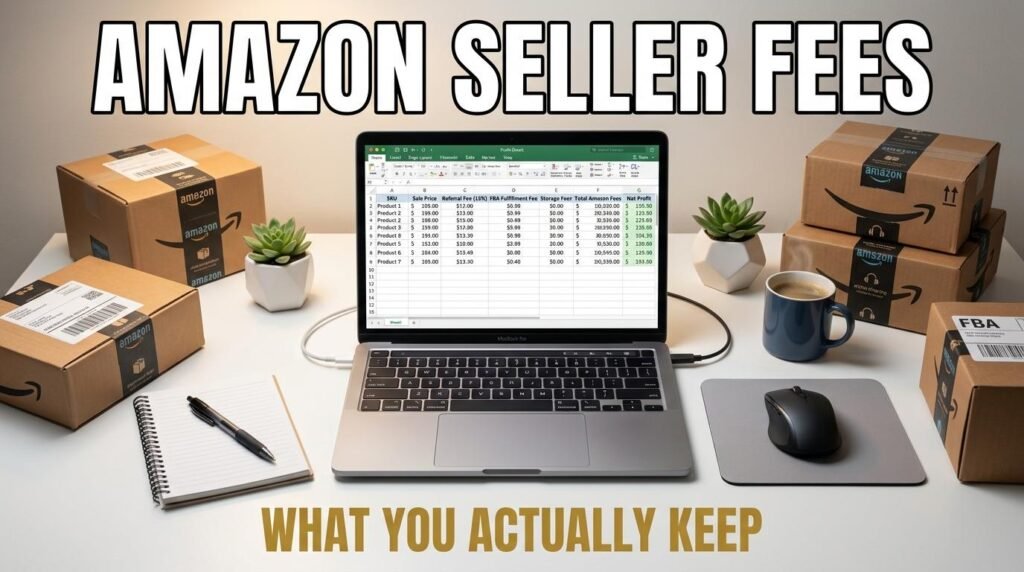
The short answer: on a typical $30 product sold through FBA, Amazon takes roughly $9 to $12 in combined fees. That means you keep about 60 to 70 percent of the selling price before your own product and shipping costs. The long answer depends on your product’s category, size, weight, and how long it sits in Amazon’s warehouse.
This guide breaks down every fee Amazon charges in 2026 so you know exactly where your money goes.
The Fees Amazon Charges on Every Sale
Amazon does not take one flat percentage. Multiple fees stack together, and understanding each one is essential for pricing your products profitably.
Referral Fee (the biggest one)
The referral fee is Amazon’s commission on every sale. It is a percentage of the total selling price including shipping, and it varies by product category. Most categories pay 15 percent. Consumer electronics, computers, and cameras pay 8 percent. Clothing and accessories pay 17 percent. Jewelry pays 20 percent, the highest rate. There is also a minimum referral fee of 30 cents per item, which matters for very low-priced products.
On a $30 product in the standard 15 percent category, the referral fee is $4.50. This is typically the single largest fee per unit.
FBA Fulfillment Fee
If you use Fulfillment by Amazon, this is the per-unit charge for Amazon to pick, pack, and ship your product to the customer. It is based on the product’s size tier and shipping weight. In 2026, the rates for standard-size products range from $3.35 for a small item under 4 ounces to about $6.90 for a large standard item up to 20 pounds. Large bulky items cost around $11.50 per unit.
Amazon uses the greater of actual weight or dimensional weight, so your product’s packaging dimensions directly affect this fee. Sellers who optimize their packaging to fit a smaller size tier save money on every unit.
Fuel and Logistics Surcharge
Since April 17, 2026, Amazon applies a 3.5 percent surcharge on top of every FBA fulfillment fee. On a $4.30 fulfillment fee, that adds about 15 cents. It sounds small per unit, but at volume it adds up — 10,000 units per month means an extra $18,000 per year in surcharges alone.
Monthly Storage Fees
Amazon charges for the warehouse space your inventory occupies. Standard-size storage costs about 78 cents per cubic foot from January through September and roughly $2.25 per cubic foot during the peak holiday season from October through December. Small, fast-selling products might cost only a few cents per unit per month. Slow-moving or bulky products can accumulate significant storage costs.
Products that sit unsold beyond 181 days trigger additional aged inventory surcharges, which increase the longer the product remains in the warehouse.
Monthly Seller Plan
The Professional selling plan costs $39.99 per month, regardless of how many units you sell. The Individual plan charges $0.99 per item sold instead of a monthly fee. Most serious sellers use the Professional plan, which works out to a negligible per-unit cost once you sell more than 40 items per month.
What Amazon Takes: A Real Example
A product sells for $29.99. You sourced it for $7.50 and paid $1.20 to ship it to Amazon’s warehouse. It is in a 15 percent referral fee category and the large standard size tier under one pound.
The referral fee is $4.50. The fulfillment fee is $4.30. The fuel surcharge is $0.15. Monthly storage is about $0.10 per unit. Total Amazon fees: $9.05.
Your total cost per unit is $7.50 plus $1.20 plus $9.05, which equals $17.75. Your net profit is $29.99 minus $17.75, which is $12.24 per unit — a 40.8 percent margin.
Now change the selling price to $19.99. The referral fee drops to $3.00, but the fulfillment fee stays the same. Total fees: $7.55. Total cost: $16.25. Profit: $3.74 — an 18.7 percent margin. The product is still profitable, but barely, and any advertising cost would wipe the margin out.
This sensitivity to price is exactly why running the numbers before committing to inventory is critical. An Amazon FBA calculator lets you test different prices and see the profit impact instantly.
FBA vs FBM: How Fees Differ
With FBA, Amazon handles storage, packing, and shipping. You pay the fulfillment fee and storage.
With FBM (Fulfilled by Merchant), you ship the product yourself. You skip the fulfillment fee and storage, but you pay your own shipping costs, packing materials, and labor. The referral fee still applies — Amazon takes its commission regardless of who ships.
FBM typically costs less per unit if you have efficient shipping, but you lose the Prime badge, which can significantly reduce your conversion rate. Most sellers find that the Prime badge justifies the higher FBA fees because it drives more sales.
Hidden Costs New Sellers Miss
Advertising is often the biggest cost beyond Amazon’s standard fees. Pay-per-click campaigns on Amazon typically cost $0.50 to $2.00 per click, and with a 10 to 15 percent conversion rate, the ad cost per sale can be $3 to $15. High-competition categories like supplements and electronics are at the top of that range.
Returns cost you twice. You lose the sale, and Amazon may charge a returns processing fee roughly equal to the fulfillment fee. Categories with high return rates like clothing and shoes can lose 2 to 4 percent of revenue to returns alone.
Inbound placement fees apply when Amazon distributes your inventory across multiple warehouses instead of letting you ship to one location. This can add 20 to 50 cents per unit.
How to Calculate Your Exact Fees
The fastest way to see exactly what Amazon takes from your product is to use a free Amazon FBA calculator. Enter your selling price, product cost, shipping cost, category, and size tier, and get the full fee breakdown, net profit, margin, ROI, and break-even price in one view. You can adjust any input to test pricing scenarios before you commit.
Frequently Asked Questions
What percentage does Amazon take from sellers?
The referral fee is typically 15 percent of the selling price for most categories, plus a fulfillment fee of $3 to $7 for standard FBA items, plus the 3.5 percent fuel surcharge and storage. Total fees on a $30 item are usually $9 to $12.
Is selling on Amazon still profitable in 2026?
Yes, but margins are tighter than they were five years ago due to increased fees, the fuel surcharge, and higher advertising costs. Careful product selection and accurate cost calculations are more important than ever.
How much does FBA cost compared to shipping myself?
FBA fulfillment fees range from $3.35 to $11.50 per unit depending on size. Whether that is more or less than self-fulfillment depends on your shipping rates, packaging costs, and labor. The trade-off is that FBA gives you the Prime badge, which typically increases sales.
Can I calculate Amazon fees without a seller account?
Yes. Amazon’s official Revenue Calculator requires a Seller Central login, but the Amazon FBA calculator on fixupeasy is free and requires no account.
See What You Keep
Know your numbers before you buy inventory. Open the Amazon FBA calculator, enter your product details, and see exactly what Amazon takes and what you keep. For more business tools, see the margin calculator and percentage calculator.