How to Calculate Concrete in Cubic Yards
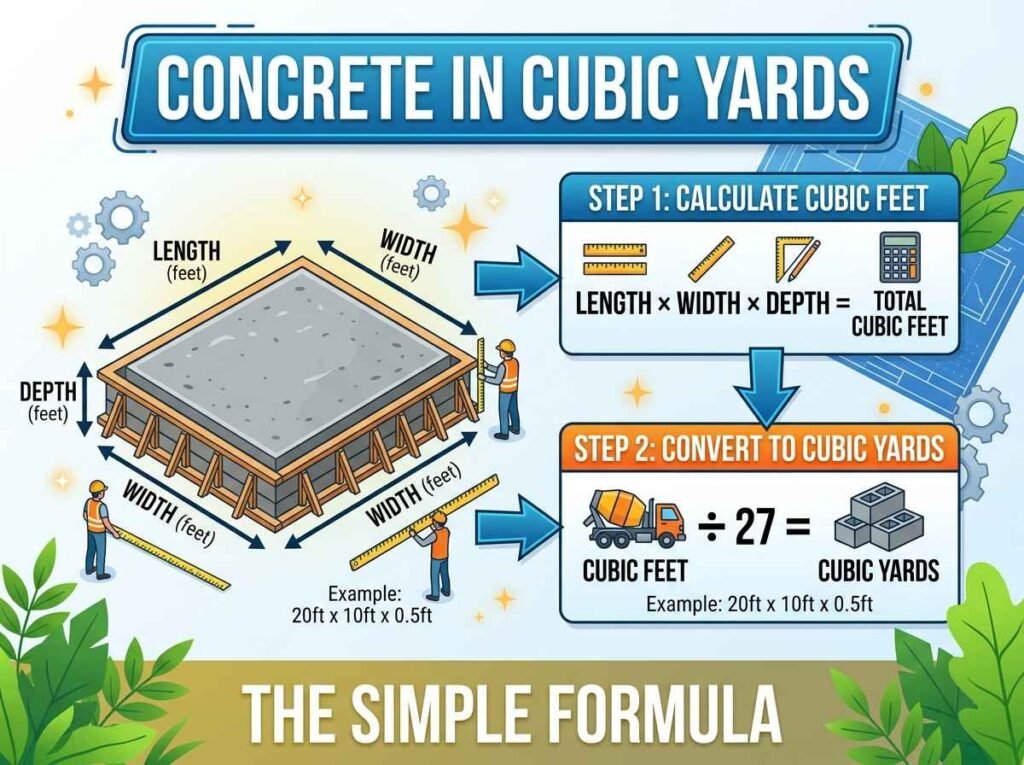
Ordering concrete means knowing exactly how much you need, and concrete is sold by the cubic yard. Order too little and your pour stops halfway; order too much and you pay for waste. Learning how to calculate concrete in cubic yards is simple once you know the formula, and it saves you money and stress on any slab, footing, or pad.
This guide walks through the math step by step, with a worked example, then shows the fastest way to get the number.
Why Concrete Is Measured in Cubic Yards
Concrete fills a three-dimensional space, so it is measured by volume, not area. In the United States, ready-mix concrete is ordered by the cubic yard. One cubic yard is the amount of concrete that fills a space three feet long, three feet wide, and three feet deep, which works out to 27 cubic feet.
Knowing this conversion is the key to the whole calculation: figure out your volume in cubic feet, then divide by 27 to get cubic yards.
The Concrete Formula
To calculate the concrete you need, you multiply the three dimensions of your slab together to get cubic feet, then convert to yards:
- Measure the length in feet.
- Measure the width in feet.
- Measure the thickness in inches, then divide by 12 to convert it to feet.
- Multiply all three together to get cubic feet.
- Divide by 27 to get cubic yards.
The thickness step trips people up most often. Slabs are usually a few inches thick, so you must convert inches to feet before multiplying, or your answer will be wildly off.
A Worked Example
Say you are pouring a patio slab that is 10 feet long, 10 feet wide, and 4 inches thick:
- Thickness in feet: 4 ÷ 12 = 0.33 feet
- Volume in cubic feet: 10 × 10 × 0.33 = 33 cubic feet
- Volume in cubic yards: 33 ÷ 27 = about 1.2 cubic yards
So you would order roughly 1.2 cubic yards, and in practice you would round up and add a little for waste, which we cover below.
Bags Versus Ready-Mix
For small jobs you might use bagged concrete instead of ordering ready-mix. Bags are measured in cubic feet of yield: an 80 lb bag yields about 0.6 cubic feet, and a 60 lb bag about 0.45. To find how many bags you need, divide your total cubic feet by the bag’s yield.
For anything larger than a small pad, ready-mix delivered by the cubic yard is usually cheaper and far less work than mixing dozens of bags by hand. A concrete calculator shows both the cubic yards for ready-mix and the bag counts, so you can compare at a glance. As a rough guide, it takes around 45 of the 80 lb bags to equal a single cubic yard, which shows just how quickly bagged concrete becomes impractical once a job grows beyond a small slab or a few post holes.
Always Add a Little Extra
Never order the exact calculated amount. Uneven ground, spillage, and slight over-digging mean you almost always need a bit more than the math suggests. Most builders add a waste allowance of 5 to 10 percent to be safe, because running short mid-pour is a serious problem once the concrete is already setting.
The Fast Way
Doing the math by hand works, but it is easy to slip on the inches-to-feet conversion. The reliable method is to use a concrete calculator: enter your length, width, and thickness, and it returns the cubic yards, cubic feet, and bag counts instantly, with a waste option built in.
Frequently Asked Questions
How do I calculate concrete in cubic yards?
Multiply length by width by thickness in feet, then divide by 27. Remember to convert the thickness from inches to feet first by dividing by 12.
How many cubic feet are in a cubic yard?
There are 27 cubic feet in one cubic yard. That is why you divide your total cubic feet by 27 to get yards.
How many bags of concrete are in a cubic yard?
It takes about 45 of the 80 lb bags or 60 of the 60 lb bags to make one cubic yard, which is why ready-mix is easier for large pours.
How much extra concrete should I order?
Add 5 to 10 percent for waste. Uneven ground and spillage mean you almost always need slightly more than the exact calculation.
Calculate Your Concrete Now
Once you know the formula, the math is quick, but a tool removes any chance of error. Open the concrete calculator to get your cubic yards and bag counts in seconds. Building a wall too? Try the brick calculator to estimate your bricks just as easily.