How to Calculate Percentage Change (With Examples)
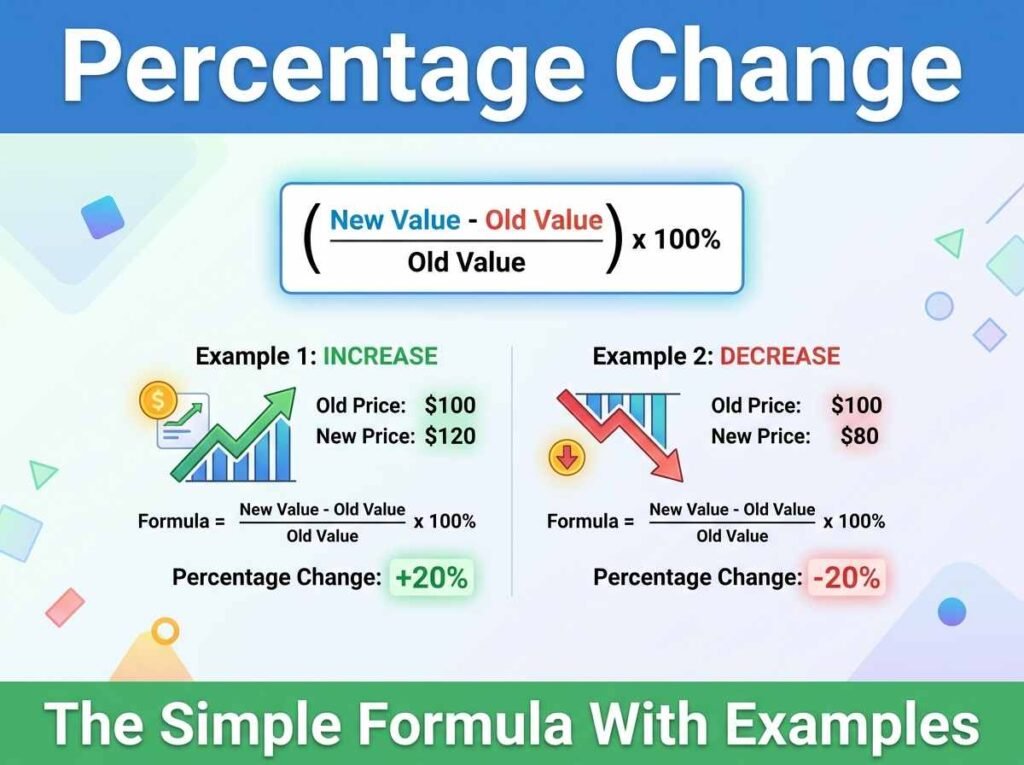
Percentage change tells you how much a number has gone up or down compared to where it started. It is the math behind price increases, sales growth, weight loss, and almost any before-and-after comparison. Once you know the simple formula, you can measure change in seconds and avoid the common mistakes people make when they rush it.
This guide explains the formula, walks through clear examples, and shows the fastest way to get an accurate answer every time.
What Percentage Change Means
Percentage change expresses the difference between two numbers as a percentage of the original value. It answers the question, how big is this change relative to where we started? A jump from 10 to 15 and a jump from 100 to 105 are both increases of 5 in raw terms, but as percentages they are very different — 50 percent versus 5 percent.
That is why percentages are so useful. They put change in context, making it easy to compare things of different sizes on equal footing.
The Percentage Change Formula
The formula is straightforward:
- Subtract the old value from the new value to get the difference.
- Divide that difference by the old value.
- Multiply by 100 to turn it into a percentage.
If the result is positive, the value increased. If it is negative, the value decreased. The key detail people miss is that you always divide by the old value, not the new one, because you are measuring change relative to the starting point.
Worked Examples
A few examples make the formula clear.
A price increase: A product rises from 80 to 100. The difference is 20. Divide 20 by the old value of 80 to get 0.25, then multiply by 100 for a 25 percent increase.
A price drop: A subscription falls from 50 to 40. The difference is minus 10. Divide minus 10 by 50 to get minus 0.2, then multiply by 100 for a 20 percent decrease.
Growth over time: Website visitors grow from 1,200 to 1,500. The difference is 300. Divide 300 by 1,200 to get 0.25, or a 25 percent increase.
Each one follows the same three steps, and the sign of the answer tells you whether it went up or down.
The Most Common Mistake
The biggest error is dividing by the wrong number. If a value goes from 80 to 100 and you divide the difference by the new value of 100, you get 20 percent — which is wrong. The correct answer is 25 percent, because the change is measured against the original 80.
Always anchor the calculation to the starting value. When you need to be sure, a percentage calculator removes the risk entirely by handling the formula for you.
When You Will Use Percentage Change
Percentage change appears all over daily life and business:
- Comparing this month’s sales to last month’s
- Measuring a price increase or a discount
- Tracking progress on a goal, like savings or fitness
- Reporting growth in traffic, followers, or revenue
Because it shows up so often, having a reliable way to calculate it saves time and prevents the small errors that creep in when you do it in your head.
The Fastest Way to Calculate It
For a quick, guaranteed-correct answer, skip the manual math. A percentage calculator includes a dedicated percentage change mode: enter the starting value and the ending value, and it returns the change as a percentage with the correct positive or negative sign. It also handles the two other common percentage questions, so it covers most everyday math in one place.
Frequently Asked Questions
What is the formula for percentage change?
Subtract the old value from the new value, divide by the old value, and multiply by 100. A positive result is an increase and a negative result is a decrease.
Do I divide by the old or new value?
Always divide by the old value, because percentage change measures the difference relative to the starting point.
How do I calculate a percentage decrease?
Use the same formula. When the new value is lower than the old one, the result is negative, which represents a decrease.
Can percentage change be more than 100 percent?
Yes. If a value more than doubles, the increase is over 100 percent. For example, going from 50 to 150 is a 200 percent increase.
Get an Instant, Accurate Answer
Percentage change is simple once you anchor it to the starting value, but a tool guarantees you never slip. Open the percentage calculator to calculate any increase or decrease in seconds. For more everyday math and money tools, see our guide to the free financial calculators everyone should use.