How to Calculate Tiles Needed for Any Room
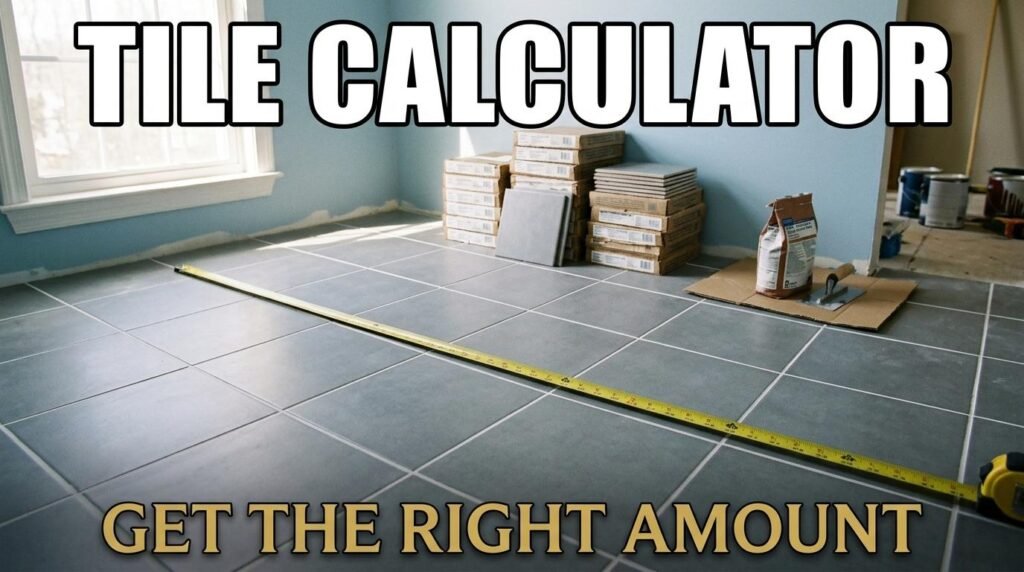
Ordering too few tiles means a second trip and a batch that might not match. Ordering too many wastes money. The calculation itself is straightforward — room area divided by tile area, plus a waste allowance — but getting the details right (grout gaps, waste percentage, boxes versus individual tiles) is where most people get tripped up.
This guide walks through the math step by step and shows how to get an accurate estimate quickly.
The Basic Formula
The formula has three parts: figure out the room area, figure out the area each tile covers, and divide the first by the second.
Room area in square feet equals the length times the width. For a room that is 12 feet by 10 feet, the area is 120 square feet.
Tile area depends on the tile dimensions and the grout gap. A 12-by-12-inch tile with a one-eighth-inch grout gap effectively covers 12.125 by 12.125 inches, or about 1.021 square feet per tile.
Divide the room area by the tile area: 120 divided by 1.021 equals about 118 tiles. Then add your waste allowance.
How Much Waste to Add
Every tile job produces waste from cuts along edges, around obstacles, and from breakage. The right waste percentage depends on the layout pattern.
A standard grid layout with straight cuts needs about 10 percent extra. Diagonal layouts produce more angled cuts and need 15 percent. Herringbone and other complex patterns can need 15 to 20 percent. Rooms with many corners, alcoves, or obstacles need more cuts and therefore more waste.
In the example above, 118 tiles plus 10 percent waste equals 130 tiles. Always round up to the next whole tile, and then round up again to whole boxes.
Accounting for Grout Gaps
The grout gap is the space between tiles filled with grout. Common gap widths are one-sixteenth inch for rectified tiles, one-eighth inch for standard floor tiles, and three-sixteenths to one-quarter inch for rustic or outdoor tiles.
The gap slightly increases the effective area each tile covers, which means you need slightly fewer tiles than if you ignored the gap. On a large floor, this can save you several tiles. The tile calculator includes the grout gap in its calculation so you get an accurate count.
Converting to Boxes
Tiles are sold by the box, and each box contains a set number of tiles. Common counts are 10, 12, 15, or 20 tiles per box, depending on the size and brand. Divide your total tiles needed (with waste) by the tiles per box and round up to the next whole box.
In the example: 130 tiles at 12 tiles per box equals 10.83, which rounds up to 11 boxes. You will have a few spare tiles, which is good — keep them for future repairs.
Wall Tiles vs Floor Tiles
The same formula works for walls. Measure the height and width of the wall area to be tiled, subtract any areas you will not tile (windows, doors, niches), and divide by the tile area. Wall tiles are often smaller (such as 4 by 8 inches or 3 by 6 inches for subway tile), so you will need more of them per square foot. Add the same waste allowance as for floors.
For a bathroom with both floor and wall tiling, calculate each surface separately and add the totals together.
Common Tile Sizes and Coverage
Knowing how many tiles cover a square foot helps with quick estimates. A 12-by-12-inch tile covers exactly 1 square foot, so you need one tile per square foot plus waste. A 6-by-6-inch tile covers 0.25 square feet, so you need 4 per square foot. A 24-by-24-inch tile covers 4 square feet, so you need 0.25 per square foot. A 3-by-6-inch subway tile covers 0.125 square feet, meaning 8 per square foot.
These are rough numbers that ignore grout gaps, but they are useful for a quick ballpark before entering exact numbers into a calculator.
Frequently Asked Questions
How do I calculate how many tiles I need?
Multiply the room length by the width to get the area in square feet, divide by the area of one tile in square feet, and add 10 to 15 percent for waste. A tile calculator does this automatically including grout gaps.
How much extra tile should I buy?
Buy 10 percent extra for a standard grid layout, 15 percent for diagonal patterns, and keep any leftover tiles for future repairs.
Does the grout gap affect the tile count?
Yes, slightly. Wider grout gaps reduce the number of tiles needed because each tile plus its surrounding gap covers more area. The difference is small but adds up on large floors.
How many 12×12 tiles do I need for 100 square feet?
About 100 tiles before waste. Add 10 percent and you need 110 tiles, or roughly 10 boxes of 12.
Calculate Your Tiles Now
Get the exact tile and box count for any room in seconds. Open the tile calculator, enter your room and tile dimensions, and see the total with waste included. For more construction estimators, see the concrete calculator, brick calculator, and plywood calculator.