What Is Compound Interest and How Does It Work?
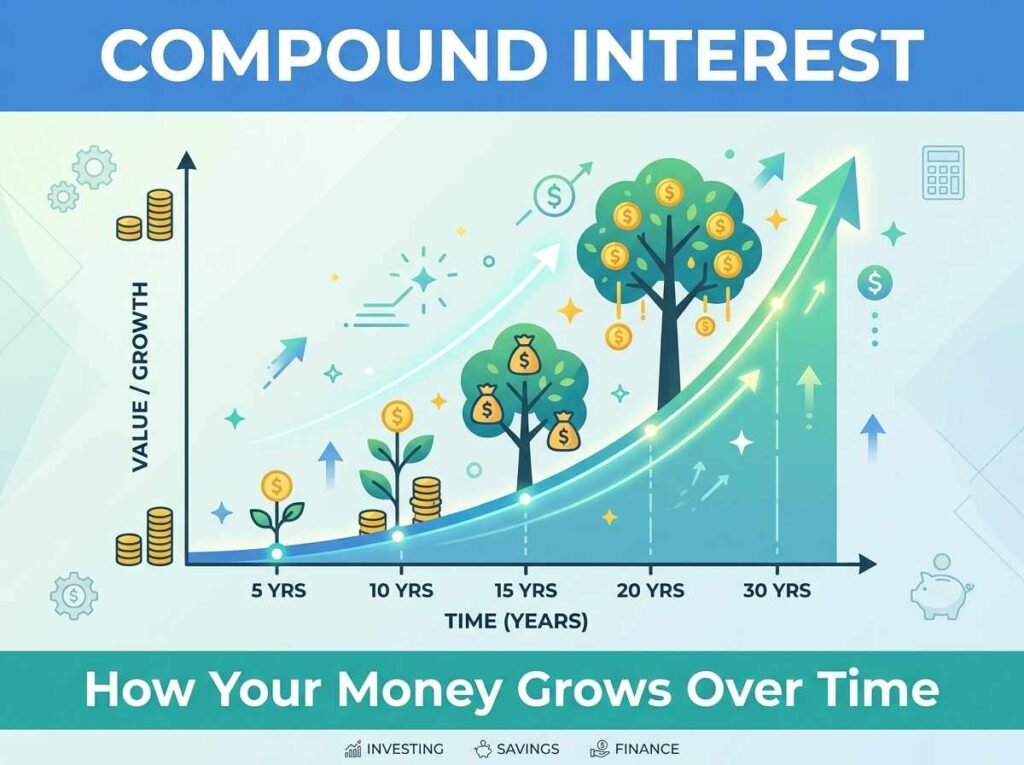
Compound interest is the reason small, steady savings can turn into a large sum over time. Put simply, it is interest earned on both the money you save and the interest that money has already earned. That second part is what makes it so powerful — your returns start earning returns of their own, and the effect builds year after year.
This guide explains how compound interest works, why time matters more than amount, and how to see the effect on your own savings.
Compound Interest Versus Simple Interest
The easiest way to understand compound interest is to compare it with simple interest. With simple interest, you earn a return only on your original amount. Save a sum at a fixed rate and you get the same interest every year, forever.
Compound interest is different. Each year’s interest is added to your balance, and the next year you earn interest on that larger balance. The growth is no longer flat — it curves upward, getting steeper the longer you leave the money to grow.
Why Time Is the Secret Ingredient
The single biggest factor in compound interest is time. Because each year builds on the last, money left to grow for decades behaves very differently from money saved for just a few years. This is why financial advice so often stresses starting early, even with small amounts.
Consider two savers who put away the same monthly amount, but one starts ten years earlier. The early starter usually ends up far ahead, not because they saved more in total, but because their money had more years to compound. Seeing this gap for yourself is eye-opening, and a compound interest calculator makes it easy to compare different starting points.
The Three Levers That Drive Growth
Three things determine how much your savings grow with compound interest:
- Starting amount — the money you begin with. A larger start gives compounding more to work with.
- Regular contributions — money you add over time. Steady deposits compound alongside your starting balance and often add up to a surprising share of the final total.
- Rate and time — the interest rate and how many years you stay invested. Higher rates and longer periods both accelerate growth.
The encouraging truth is that even modest contributions, left to compound for many years, can outgrow a larger one-time deposit that has less time to work.
How Compounding Frequency Affects Your Returns
Interest can be added to your balance at different intervals — yearly, quarterly, monthly, or daily. The more often it compounds, the faster your balance grows, because each addition starts earning interest sooner.
The difference between monthly and daily compounding is small over a single year, but across decades it adds up. When you compare savings options, it is worth checking how often interest compounds, not just the headline rate. A compound interest calculator lets you switch the frequency and watch the final balance change.
How to See Compound Interest on Your Own Savings
The clearest way to understand compounding is to model your real numbers:
- Enter your starting amount and a realistic monthly contribution.
- Add the interest rate you expect to earn.
- Set the number of years you plan to save.
- Review the future balance and how much of it is interest versus your own deposits.
Watching the interest portion overtake your contributions over time is the moment compound interest truly clicks. It turns an abstract idea into a concrete plan.
Frequently Asked Questions
What is the formula for compound interest?
The basic formula is A equals P times one plus r over n, raised to the power of n times t. P is the principal, r is the annual rate, n is how often it compounds per year, and t is the number of years.
How is compound interest different from simple interest?
Simple interest is earned only on your original amount. Compound interest is earned on your original amount plus all the interest already added, so it grows faster over time.
Do regular contributions make a big difference?
Yes. Small, steady deposits compound alongside your starting balance and often make up a large share of the final total over many years.
Does compounding frequency really matter?
It does over long periods. More frequent compounding, such as daily versus yearly, produces a higher final balance at the same rate.
See Your Savings Snowball
Compound interest rewards two things above all: starting early and staying consistent. To see what your own plan could become, open the compound interest calculator, enter your numbers, and watch the growth year by year. For more ways to plan your money, read our guide to the free financial calculators everyone should use.